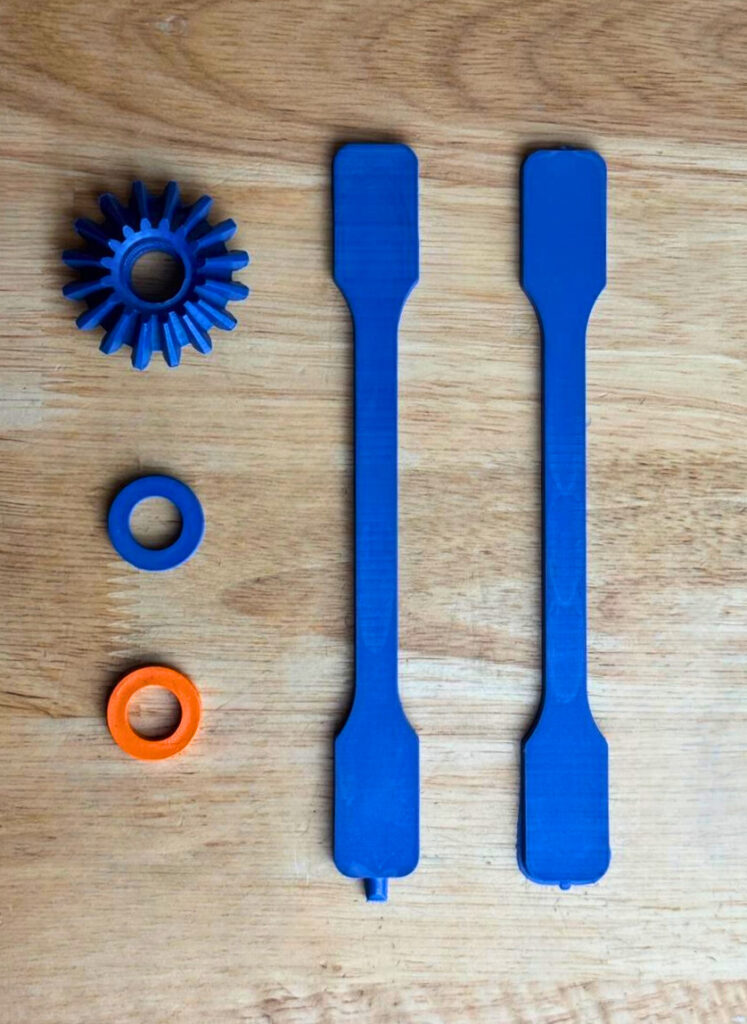
PEEK (Polyetheretherketone) is a high-performance thermoplastic renowned for its excellent mechanical and chemical resistance. This engineering plastic has established itself in numerous industrial applications thanks to its exceptional properties. Discover the characteristics of this premium product, its price, and its machining possibilities.
PEEK is available in three main variants, each optimized for specific applications:
In the plastics industry, we hear a lot about PEEK, but do we really know it? Between PEEK, PEKK, and PEAK, the details often remain blurred. In this article, let’s take a closer look.
PEEK and PEKK belong to the same family of high-performance plastics: PAEKs. PEEK (Polyetheretherketone) is the most well-known: it withstands high temperatures (approx. 250°C continuous), has excellent chemical resistance, and retains superior mechanical properties.
PEKK (Polyetherketoneketone) has a similar chemical structure but is easier to process because its processing temperature is lower and its crystallinity can be adjusted (making it more rigid or tougher). It is easier to shape than PEEK and is widely used in FDM 3D printing.
As for PEAK, it does exist as a polymer in the same family, but it is rarely used; the name usually appears due to confusion with PEEK. In practice, the industry primarily works with PEEK and, increasingly, PEKK.
But let’s get back to PEEK, the subject of this article.
The chemical resistance of PEEK makes it a product of choice for the chemical industry. This plastic resists most solvents and acids, maintaining its mechanical properties even in aggressive environments.
PEEK is also biocompatible, sterilizable, and has low flammability (self-extinguishing).
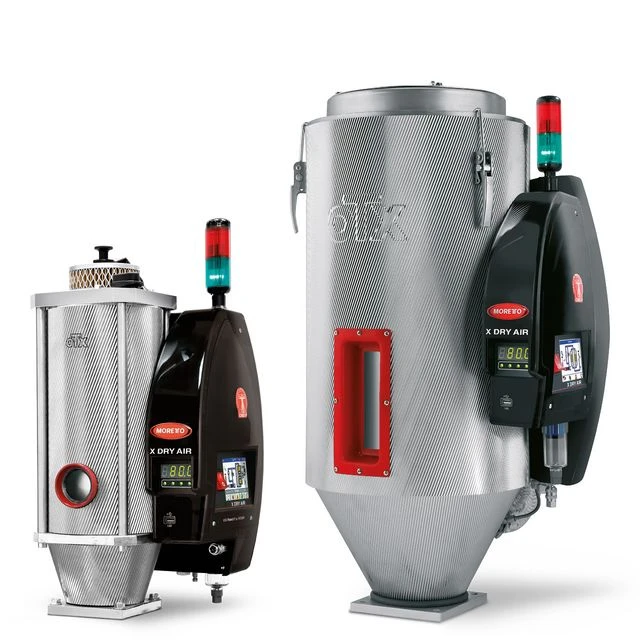
PEEK cannot be molded like ABS or PLA. Its processing requires:
It is also difficult to bond and machine, requiring specialized tools and surface treatments if necessary.
The exceptional mechanical resistance of PEEK, combined with its chemical resistance, explains the high price of this product. The mechanical properties of PEEK remain stable even at high temperatures, unlike standard plastics.
Implants, sterilizable surgical instruments
Biocompatible, rigidity close to bone
Engine components, conduits, lightweight parts
Resistance to heat, chemicals, fire, and vibrations
Seals, gears, insulators, transmission parts
Low friction, heat resistance, stability
Bearings, bushings, fluid contact parts
Minimal wear, dimensional stability
Connectors, insulators, printed circuit boards
Stable electrical insulation at high temperatures
Pumps, valves, seals, linings
Chemical inertia even when hot
Tools machined from rods or sheets
High hardness
PEEK is available in several specialized ranges depending on the application: versions optimized for mechanical use, formulations for harsh environments, and variants suitable for electronics.

Several alternatives to PEEK exist depending on the target application. For consumer and light industrial use, ABS, Acrylic (PMMA), Polycarbonate, or Polyethylene are perfectly suitable for non-critical parts at room temperature. For more technical applications, Nylon (PA) offers good wear resistance for gears, PTFE excels in chemical environments, and Ultem (PEI) is the closest alternative to PEEK for temperatures up to 180°C. PEKK remains the reference for ultimate performance, but these more accessible polymers can often fulfill the same function with substantial gains in cost and ease of processing.
These materials fit perfectly into a prototyping cost reduction strategy when combined with the HoliPress, allowing for significant savings and reduced R&D time, provided the end-use is compatible with the specific properties of the chosen material.
PEEK is not as easy to work with as other thermoplastics. A project involving this material can quickly become expensive, even during the testing and prototyping phases. Until now, very costly industrial equipment was required to reach the necessary temperatures and pressures.
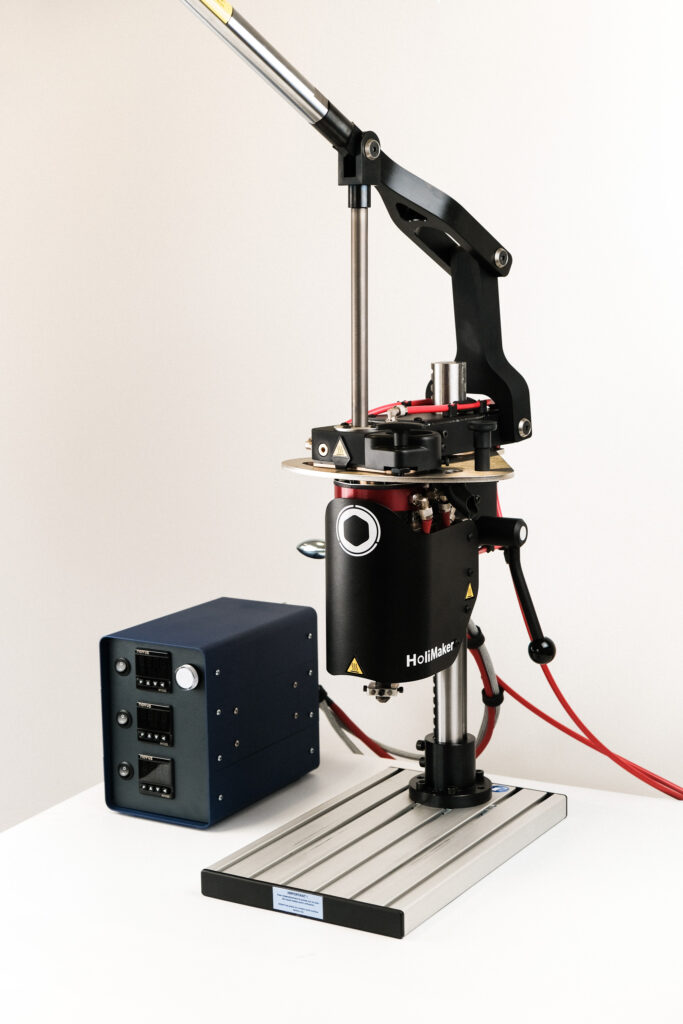
But a new manual high-temperature press has arrived at HoliMaker: the HoliPress High Temp.
This new press allows for the molding of high-performance polymers like PEEK, PEI, or PPS on a small scale. It opens the door to experimentation and production in labs, R&D, or small technical series.
While the first HoliPress models reached 320°C, this model goes up to 500°C, with a capacity of 35 to 38 cm³. It still features a heated nozzle for flawless injection right into the mold, and a reinforced, length-adjustable lever for greater force.
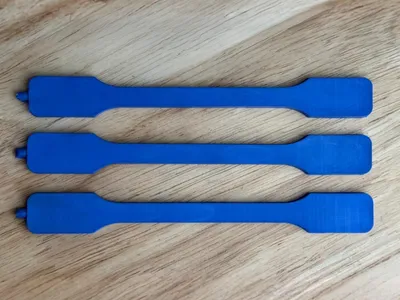
Material: Vestakeep 2000 G
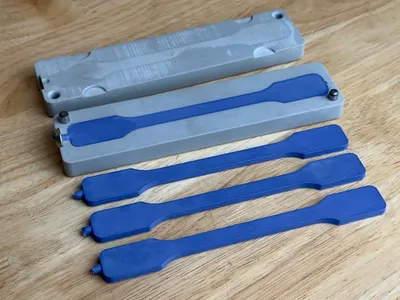
Find out more about tensile test tubes in our dedicated article.
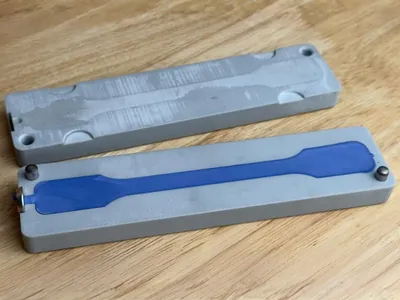
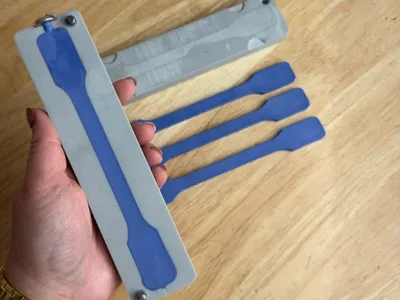
The mold used for these tests was manufactured by ERM Fab&Test using resin 3D printing on a DWS SYSTEMS DW029 MKIII machine.
The material used is DWS Therma DM570 high-temperature resin, specifically formulated to withstand significant thermal stress. This resin features a Heat Deflection Temperature (HDT) of 163°C and good dimensional stability, enabling the production of prototype molds suitable for injection testing of engineering polymers.
During tests, material injection was carried out at temperatures reaching 450°C.
Although the injection temperature is very high, the mold is only exposed to this heat for a very short time during the cavity filling. The heat is rapidly transferred to the injected part and dissipated as the part cools. Thanks to its high-temperature formulation and good mechanical strength, Therma DM570 resin can withstand these short thermal cycles while maintaining sufficient stability for prototype manufacturing. Under these conditions, this type of mold generally allows for the production of functional prototypes and even series of a few hundred parts, depending on the part geometry and processing parameters.
The combination of 3D-printed molds with manual plastic injection allows for the rapid testing of technical materials like PEEK without the long and costly process of manufacturing a metal mold. It is an ideal solution for R&D and part validation before industrialization.
Nadège André, Application Engineer - ERM Fab&Test
Key takeaways
Share on